 Zealous Fitness
Animal Flow is a ground-based bodyweight movement system created by fitness coach Mike Fitch. You move on hands and feet through positions such as beast, crab and ape, then link them into flowing sequences, training strength, mobility and coordination together. It needs no equipment, and a 2022 study measured a 60-minute beginner class at moderate intensity, slightly harder than walking at your own pace.
It looks part breakdance, part yoga, part gymnastics, but underneath the fluid flows is a structured progression a complete beginner can follow. Here is how it is organised, what the main moves look like, what the research says so far, and how to start.
How Animal Flow is structured
Rather than a random set of crawls, Animal Flow is organised into components that build on each other:
| Component | What you do | Why it matters |
|---|---|---|
| Wrist mobilisations | Circles, rocks and gentle loading on hands | Most of the work is on your hands |
| Activations | Static holds in beast and crab | Switches on shoulders, trunk and hips |
| Form-specific stretches | Mobility moves that flow out of the base positions | Opens hips, hamstrings, shoulders, upper back |
| Travelling forms | Moving across the floor in beast, crab or ape | Builds coordination and work capacity |
| Switches and transitions | Rotating from one position into another | Trains rotation, which many gym plans ignore |
| Flows | Linking moves into a continuous sequence | Where it starts to feel like "flow" |
A 2022 study in Frontiers in Sports and Active Living measured the segments of a 60-minute beginner class. Wrist work was light (about 2.5 METs), activations and form stretches were moderate (4.0 and 5.1), and switches and the final flow reached vigorous intensity (6.1 and 7.0).
The core Animal Flow movements, explained simply
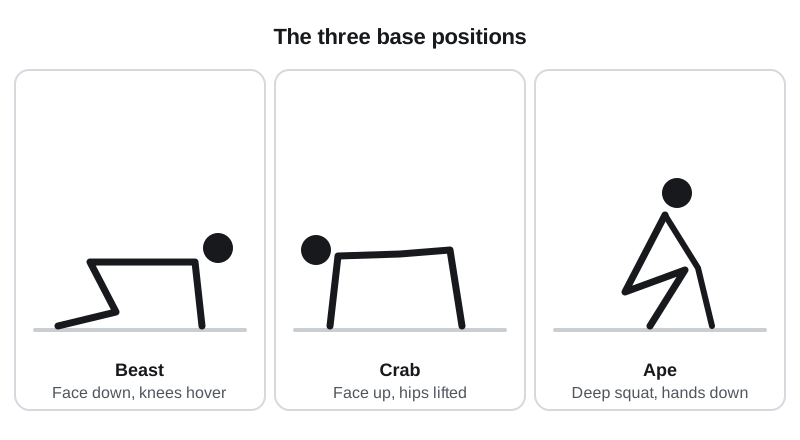 The three base positions most beginner sessions are built on.
Beast
On hands and feet, facing the floor, knees bent and hovering just above the ground, back flat. A static beast hold is a deceptively hard trunk and shoulder exercise. Travelling beast means crawling forwards, backwards or sideways while keeping that low, steady position.
Crab
The reverse of beast. You face the ceiling with hands behind you and feet in front, hips lifted. It works the backs of the shoulders, glutes and upper back, and opens the front of the chest. Many people who sit at a desk all day find it hard precisely because the chest and shoulders are tight.
Ape
A deep, wide squat with hands on the floor in front. Ape travels sideways: shift your weight onto your hands and hop or step your feet across. It builds hip mobility and teaches you to load your arms.
Switches and kickthroughs
From beast, rotate your body, lift one hand and thread a leg through underneath, ending in a crab-like position before returning. These transitions train controlled rotation.
What the research says about Animal Flow
The evidence is small but growing, and much of it comes from one research group.
- Intensity: In the 2022 Frontiers study, 30 healthy young adults new to the method burned about 6.7 kcal per minute in a 60-minute beginner class, versus 5.1 kcal per minute walking at their own pace. That averaged 5.4 METs, which the authors classed as moderate intensity, and counts towards the WHO's 150–300 weekly minutes of moderate activity.
- Movement quality: In a randomised trial by Buxton and colleagues (Journal of Strength and Conditioning Research, 2022), 42 active college-age adults did two 60-minute classes a week for 8 weeks or carried on as normal. The training group improved more on the Functional Movement Screen and several active joint ranges of motion, but not on balance, upper-body strength or push-up endurance.
- Coordination: In a 2016 study by Matthews and colleagues (Human Movement Science), 22 sports science students did four weeks of quadrupedal training. They improved on a card-sorting test of mental flexibility, and joint position sense improved only at the shoulder angle they had trained.
All three are small studies in young, healthy people, and the first two come from the same research group. Treat them as promising hints, not proof. None tested people over 50 or people with back pain.
Benefits for mobility and more
- Active mobility. You move joints through a wide range while supporting your own weight.
- Shoulder and wrist tolerance. Regular, controlled loading of the hands builds it gradually.
- Trunk strength from every angle. Beast and crab demand a steady trunk while limbs move.
- Coordination. Moving opposite hand and foot together, or rotating under control, improves quickly with practice.
- A break from sitting. For people spending nine or ten hours at a desk in Cyber City or Udyog Vihar, getting down on the floor and moving the hips and upper back feels particularly useful.
The WHO recommends muscle-strengthening activity on at least two days a week; Animal Flow can count towards that, alone or alongside lifting.
Animal Flow vs yoga, TRX and weights
| If your main goal is | Animal Flow | Yoga | TRX | Weights |
|---|---|---|---|---|
| Active mobility and body control | Strong | Strong | Moderate | Moderate |
| Building muscle and bone strength | Moderate | Low to moderate | Moderate | Strong |
| Wrist-friendly training | Low (loads wrists) | Moderate | Strong | Strong |
| Equipment needed | None | A mat | Straps and an anchor | Gym or weights |
| Learning curve | Steep for flows | Gentle | Gentle | Moderate |
These are general comparisons, not study findings. Many people combine two: weights for strength, Animal Flow as a warm-up or mobility day.
Who it suits, and who might prefer something else
Animal Flow works well for:
- Beginners wanting low-impact body control before heavier training
- Lifters wanting better shoulder and hip mobility for squats, presses and pulls
- Runners and cyclists who mostly move in one plane
- Anyone bored with machines who wants training that feels more like play
When something else suits you better: if your main goal is building a lot of muscle or bone strength, progressive weight training does that more directly. If you have wrist, shoulder or knee pain, you may need modifications or a physiotherapist's input first. If you have a medical condition, an injury, or are pregnant, check with your doctor before starting.
How a beginner starts
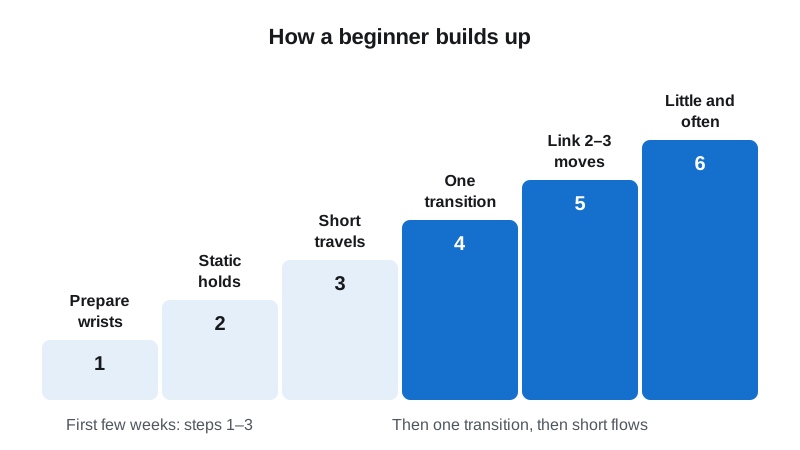 Climb one step at a time; expect to spend a few weeks on the first three.
- Prepare your wrists every time. Three to five minutes of circles, rocking and gentle loading on hands and knees.
- Learn the static holds. Hold beast for 10–20 seconds, rest, repeat 3–5 times. Same for crab.
- Add short travels. Two or three steps of beast forward and back, then crab, then ape. Slowly.
- Learn one transition. A basic switch from beast to crab and back is enough for the first few weeks.
- Link two or three moves. Only once each piece feels steady.
- Practise little and often. Two or three 15–20 minute sessions a week.
A first 15-minute session might look like this:
| Minutes | Block | Detail |
|---|---|---|
| 0–4 | Wrist preparation | Circles, rocks forward and back, gentle loading on hands and knees |
| 4–8 | Static holds | Beast hold 15 s, rest 15 s, × 4; then crab hold the same way |
| 8–12 | Short travels | 3 steps of beast forward and back, 3 of crab, 2 of ape each way; rest as needed |
| 12–15 | One transition | Beast to crab switch, slowly, 3–4 per side |
The biggest beginner mistake is copying long flows from Instagram. A coach mainly helps by spotting what you cannot see yourself: hips too high in beast, elbows locked in crab, wrists collapsing. On high-AQI winter days in Gurgaon, a 15-minute indoor floor session is also an easy swap for an outdoor run.
Animal Flow pairs well with other training. If you lift, see strength training for beginners. For another bodyweight option, read a TRX workout for beginners.
Sources
- Buxton JD et al. A comparison of the energy demands of quadrupedal movement training to walking, Frontiers in Sports and Active Living (2022)
- Buxton JD et al. The effects of a novel quadrupedal movement training program on functional movement, range of motion, muscular strength, and endurance, Journal of Strength and Conditioning Research (2022), PubMed
- Matthews MJ et al. Quadrupedal movement training improves markers of cognition and joint repositioning, Human Movement Science (2016), PubMed
- WHO: physical activity recommendations for adults
- Animal Flow, official programme site (animalflow.com)
Frequently asked questions
What is Animal Flow workout?
It is a bodyweight training system done on the floor, moving on hands and feet through positions like beast, crab and ape and linking them into flows. It was created by Mike Fitch and combines strength, mobility and coordination work. No equipment is needed.
Is Animal Flow good for complete beginners?
Yes, if you start with static holds and short travels rather than full flows. The movements scale down a long way, and most people notice better control within a few weeks of regular practice.
Can Animal Flow build muscle?
It builds strength and muscular endurance, especially in the shoulders, trunk and hips. For significant muscle growth, most people combine it with progressive weight training.
How many calories does Animal Flow burn?
In one 2022 study, young adults burned about 6.7 kcal per minute in a 60-minute beginner class, a little more than walking at their own pace. Your number will depend on your size, fitness and how hard you work.
How often should I do Animal Flow?
Two or three short sessions a week is a sensible start. It also works as a 10-minute warm-up before strength training.
Is Animal Flow hard on the wrists?
It loads the wrists more than most training, which is why every session starts with wrist preparation. Build up gradually, and if you have existing wrist pain, see a doctor or physiotherapist first.
Train with us
Animal Flow is one of the programmes we run at Zealous. Visit our DLF Phase 4 gym, open now, or our Sector 43 gym near HUDA City Centre metro, opening 1 January 2027. For timings and how to join a session, message us on WhatsApp at +91 81303 92980.