 Zealous Fitness
Exercise outdoors in Gurgaon only when the AQI is 200 or below, and keep hard or long sessions for days under 100. From 201 (Poor, which is also when GRAP Stage I starts in the NCR) move running, cycling and intervals indoors; from 301 (Very poor) keep all exercise indoors; above 400 (Severe) train indoors and lighter, because CPCB says health effects can appear even during light activity. If you have asthma, heart or lung disease, are older, pregnant or training a child, move indoors one band earlier.
Do not stop exercising for the winter. The WHO still recommends at least 150 minutes of moderate activity a week, and a habit dropped for the whole smog season is hard to restart in February. The goal is to move the hard breathing indoors, not to cancel it.
Why exercising outdoors at high AQI is different
During a run you breathe far more air per minute than at rest, faster, deeper and often through your mouth, so far more fine particles (PM2.5) reach your lungs per minute. A 2014 review in Sports Medicine by Giles and Koehle on the health effects of exercising in polluted air describes effects on the lungs, heart and blood vessels, and recommends reducing exposure by choosing when and where you train.
The WHO's air pollution fact sheet links outdoor air pollution to an estimated 4.2 million premature deaths worldwide in 2019, most from heart disease and stroke, followed by COPD, lung infections and lung cancer.
How worried should a healthy adult be about one outdoor run? Less than that number suggests. A 2016 modelling study in Preventive Medicine (Tainio and colleagues) asked when air pollution cancels out the long-term benefit of cycling and walking. At a sustained PM2.5 level of 100 µg/m³, which sits in India's Poor band, harm overtook benefit only after about 90 minutes of cycling a day, every day; for walking it took more than 10 hours. That is a model of long-term risk, not of how you feel that morning, and it does not apply to people with heart or lung disease. But it supports a sensible middle path: short, easy outdoor activity on moderate days is fine; long, hard sessions on bad days are what to move indoors.
AQI bands, GRAP stages and what to do
India's National Air Quality Index from the Central Pollution Control Board (CPCB) has six categories. Each has an official health statement. Gurugram is in the NCR, so the Commission for Air Quality Management's Graded Response Action Plan (GRAP) stages also apply here; they track the same AQI numbers, so when you hear "GRAP Stage II is in force", you know the air is already Very poor.
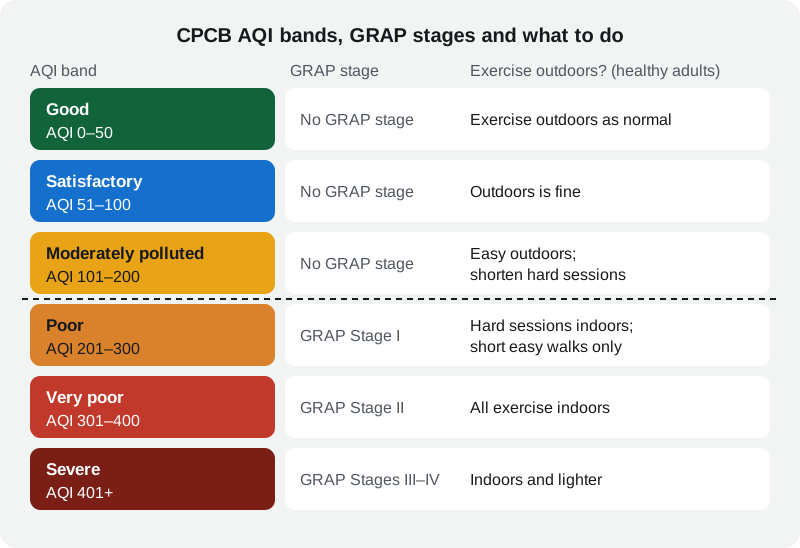 The switch point for hard outdoor sessions is AQI 200, the same point at which GRAP Stage I begins.
| AQI | CPCB category | GRAP stage | CPCB health statement (summarised) | Exercise outdoors? (healthy adults) |
|---|---|---|---|---|
| 0–50 | Good | None | Minimal impact | Yes, as normal |
| 51–100 | Satisfactory | None | Minor breathing discomfort for sensitive people | Yes |
| 101–200 | Moderately polluted | None | Discomfort for people with asthma, heart disease, children and older adults | Easy sessions yes; shorten hard ones, avoid main roads |
| 201–300 | Poor | Stage I | Breathing discomfort on prolonged exposure | Short, easy walks only; hard sessions indoors |
| 301–400 | Very poor | Stage II | Respiratory illness on prolonged exposure | No; train indoors |
| 401–450 | Severe | Stage III | Affects healthy people; effects possible even during light activity | No; indoors and lighter |
| Above 450 | Severe | Stage IV | As above | No; indoors and lighter |
CPCB's PM2.5 cut-offs show how sharp the jumps are: up to 60 µg/m³ is Satisfactory, 91–120 is Poor, and anything above 250 is Severe (24-hour averages). The exercise column is our conservative reading of the official categories, not medical advice.
How to check the AQI before you go out
- Use the station nearest you. Readings across Gurugram can differ a lot on the same morning. CPCB's SAMEER app shows individual monitoring stations, so pick the one closest to where you will actually be, not a city average.
- Look at the last few hours, not one number. If the AQI is climbing, go earlier or go indoors.
- Do not assume early morning is cleaner. An IndiaSpend sensor analysis of Delhi in spring 2016 found PM2.5 peaked around 7 am and was lowest around 4 pm. Winter patterns vary, which is why checking beats assuming.
- Watch GRAP news. When Stage II or higher is announced for the NCR, plan the week indoors.
Worked example: a Thursday in late November
Your nearest station reads 320 at 6:30 am and 250 by 4 pm. A 6:30 am park run is out (Very poor). At 4 pm it is Poor, so a 15-minute easy walk away from traffic is reasonable, but your interval session belongs on a treadmill or bike. If you have asthma, keep both indoors.
A smog-season training week
When the AQI sits in the 300s for days, a structure like this keeps you progressing:
| Day | Session | Time |
|---|---|---|
| Monday | Strength: squat, row, press, Romanian deadlift, 3 sets of 8–10 | 45 min |
| Tuesday | Indoor intervals: 5 min easy, 6 × 1 min hard / 2 min easy, 5 min easy | 30 min |
| Wednesday | Mobility or Pilates-style core work | 30 min |
| Thursday | Strength: lunge, push-up or bench press, pulldown, carry, 3 sets | 45 min |
| Friday | Rest, or an easy indoor walk | 20–30 min |
| Saturday | Steady indoor bike, rower or cross-trainer at a talking pace | 40 min |
| Sunday | Rest | — |
That adds up to well over 150 minutes, with two strength days, which meets the WHO and NHS adult guidelines. Strength work suits bad-air weeks because it builds fitness without long periods of heavy breathing. Our strength training and cardio programmes cover both halves, and strength training for beginners has a first-month plan.
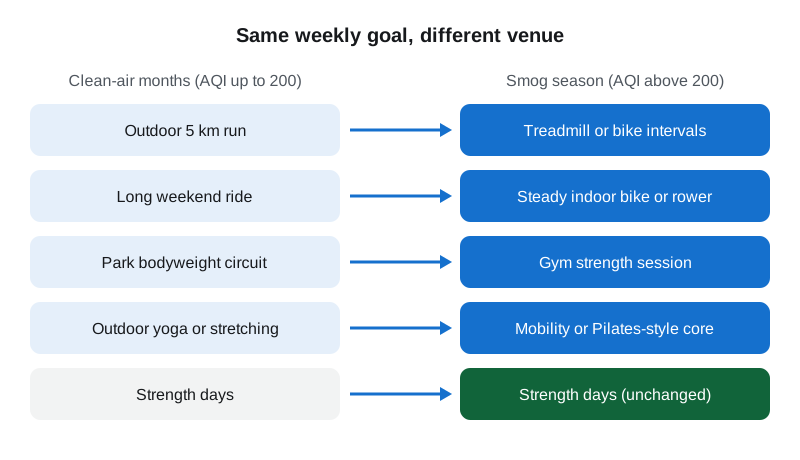 You do not lose the week, you move it: strength days stay, outdoor cardio swaps for an indoor equivalent.
Indoor air is better but not automatically clean. At home, keep windows shut on bad days; a room air purifier can reduce particles. In a gym, ask how ventilation and filtration work if it matters to you.
Masks, commutes and the walk to the gym
- For commuting and errands, an N95 that seals well helps. "N95" means the filter removes at least 95% of airborne particles in NIOSH testing; it only works if air goes through the filter, not round the edges.
- Do not run in a tight N95. It makes hard breathing uncomfortable. Move the session indoors instead.
- In the car, keep windows up and set ventilation to recirculate on Poor or worse days.
- On foot, use quieter lanes and parks rather than footpaths along NH-48, MG Road or Golf Course Road at rush hour. Distance from traffic matters.
Who should be more careful
CPCB's own statements single out people with lung disease such as asthma, people with heart disease, children and older adults from the Moderately polluted band upwards. Talk to your doctor about a plan for November to January if you:
- Have asthma, COPD or another lung condition (carry your reliever inhaler if prescribed)
- Have heart disease or high blood pressure
- Are pregnant
- Are over 60, or are training a child or teenager
- Are recovering from a chest infection
Stop and seek medical advice if you get chest pain or tightness, unusual breathlessness, wheezing, dizziness or palpitations, indoors or out.
A sauna after training can feel good in winter, but it does not clear pollution from your lungs; see sauna after a workout for what it can and cannot do. To fit indoor sessions around office hours, read best time to go to the gym for working professionals.
Sources
- Arthapedia (Indian Economic Service): National Air Quality Index, CPCB categories, health statements and PM2.5 breakpoints
- Commission for Air Quality Management, revised Graded Response Action Plan for the NCR (PIB release, 28 July 2023); stage thresholds also summarised by Outlook India, October 2025
- Tainio M et al. Can air pollution negate the health benefits of cycling and walking? Preventive Medicine, 2016
- Giles LV, Koehle MS. The health effects of exercising in air pollution. Sports Medicine, 2014
- WHO fact sheet: ambient (outdoor) air pollution
- WHO fact sheet: physical activity
- NHS: physical activity guidelines for adults aged 19 to 64
- IndiaSpend #Breathe sensor analysis, via Newslaundry, April 2016
- CDC NIOSH: what the N95 filter class means
- CPCB SAMEER app (Google Play and the App Store)
Frequently asked questions
Is it safe to exercise outdoors in Gurgaon at high AQI?
Not for hard or long sessions. Once the AQI goes above 200 (Poor), move running, cycling and intervals indoors; above 300, keep all exercise indoors. At 101–200, easy outdoor exercise away from traffic is reasonable for most healthy adults.
At what AQI should I stop running outside?
A conservative cut-off is 200. Above that, run on a treadmill. If you have asthma or a heart or lung condition, stop outdoor running from the Moderately polluted band (101–200) and ask your doctor for a personal threshold.
Is morning or evening better for outdoor exercise in Gurgaon pollution?
Neither is reliably cleaner. One sensor analysis in Delhi found PM2.5 highest around 7 am and lowest around 4 pm, but winter days vary. Check the live reading at your nearest station and go when it is lowest, or train indoors.
What does GRAP Stage 1, 2, 3 or 4 mean for my workout?
GRAP stages follow the AQI: Stage I is 201–300, Stage II 301–400, Stage III 401–450 and Stage IV above 450. In practice, Stage I means hard sessions go indoors, and Stage II or higher means all exercise goes indoors.
Does wearing an N95 mask while running help?
An N95 filters fine particles if it seals well, but it makes hard running uncomfortable. Use it for your commute and walk to the gym, and move the run itself indoors on bad days.
Is gym air better than outside air in Gurgaon?
Usually, because walls and closed doors keep out some outdoor pollution, but it depends on ventilation and filtration. Ask the gym how it manages air if this matters to you.
Train with us
When the AQI turns, our DLF Phase 4 gym is open now for indoor strength and cardio. Our premium Sector 43 gym, opening on 1 January 2027 near HUDA City Centre metro, has Pilates and a sauna confirmed; ask us on WhatsApp at +91 81303 92980 for the full amenity list.