 Zealous Fitness
Strength training for beginners works best with two or three full-body sessions a week, six basic movement patterns, and weights light enough for 2–3 sets of 8–12 clean reps. Add one or two reps or one small weight step a week, only when every rep looks the same. In month one, aim for consistency and technique, not heavy lifting.
Below: two ready-made sessions to alternate, a week-by-week plan, the six movements to learn, what normal soreness feels like, and when paying for a coach makes sense.
How often to train in month one
Two or three full-body sessions a week, with at least one rest day between them, is plenty. The WHO and the NHS both recommend muscle-strengthening activity on two or more days a week for adults, so two sessions already meet the baseline.
| Schedule | Strength days | Other days |
|---|---|---|
| Two days | Monday, Thursday | Walk 30 minutes on two or three days |
| Three days | Monday, Wednesday, Friday | Walk or light cycling on one or two days |
If you work long hours in Cyber City or on Golf Course Road, two sessions you never miss beat three you keep missing. Book them in your calendar like meetings, and pick a gym near home so a late finish or a jam on NH-48 does not cancel the session. Our guide to a morning workout before office shows how to fit a session in before 9:30 am.
The six movement patterns to learn
Almost every strength programme is built from the same handful of patterns. Learn these and you can follow any plan later.
| Pattern | Beginner exercise | Muscles worked |
|---|---|---|
| Squat | Goblet squat or box squat | Thighs, glutes, core |
| Hinge | Dumbbell Romanian deadlift, glute bridge | Hamstrings, glutes, lower back |
| Horizontal push | Incline push-up, dumbbell bench press | Chest, shoulders, triceps |
| Horizontal pull | Seated cable row, one-arm dumbbell row | Upper back, biceps |
| Vertical push and pull | Dumbbell shoulder press, lat pulldown | Shoulders, upper back |
| Carry and core | Farmer's carry, plank, dead bug | Grip, trunk, posture |
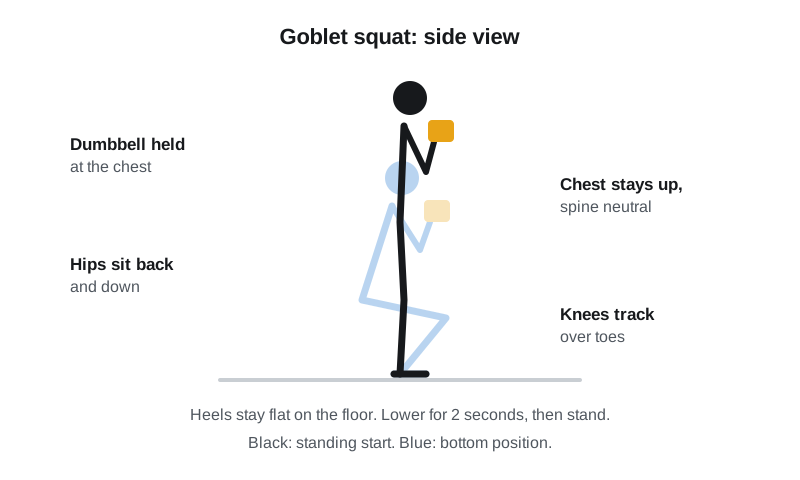 The goblet squat: hold one dumbbell at the chest, sit the hips back and down, keep the chest up, then stand.
Start with the goblet squat because holding the weight in front of your chest naturally keeps your torso upright. Lunges and step-ups are good additions once squats feel smooth.
Sets, reps and rest for beginners
- Sets: 2–3 per exercise
- Reps: 8–12 for most lifts; 20–40 second holds for planks
- Rest: 60–90 seconds between sets
- Effort: finish each set feeling you could do 2–3 more reps
A session of five or six exercises takes 40–50 minutes with a warm-up of 5–10 minutes (easy bike or rower, then a few bodyweight squats, hinges and arm circles).
Session A and session B
Alternate two full-body sessions so every pattern gets trained twice a week without doing the same workout every time. On a two-day week, do A on Monday and B on Thursday. On a three-day week, run A, B, A one week and B, A, B the next.
| Order | Session A | Session B | Sets × reps |
|---|---|---|---|
| 1 | Goblet squat | Leg press | 2–3 × 8–12 |
| 2 | Dumbbell bench press or incline push-up | Dumbbell shoulder press | 2–3 × 8–12 |
| 3 | Seated cable row | Lat pulldown | 2–3 × 8–12 |
| 4 | Glute bridge | Dumbbell Romanian deadlift | 2–3 × 8–12 |
| 5 | Plank | Dead bug | 2–3 × 20–40 s / 6–8 per side |
| 6 | Farmer's carry | Farmer's carry | 2–3 × 30 m |
Machines (leg press, cable row, lat pulldown) sit alongside dumbbells deliberately: they let you learn the pattern while the free-weight version catches up.
If your lower back is stiff or sensitive: start with the glute bridge, leg press and machine rows, keep the Romanian deadlift to bodyweight or very light dumbbells for the first fortnight, and skip anything that causes sharp or radiating pain. A physiotherapist or doctor should check persistent back pain before you load it.
Your four-week plan
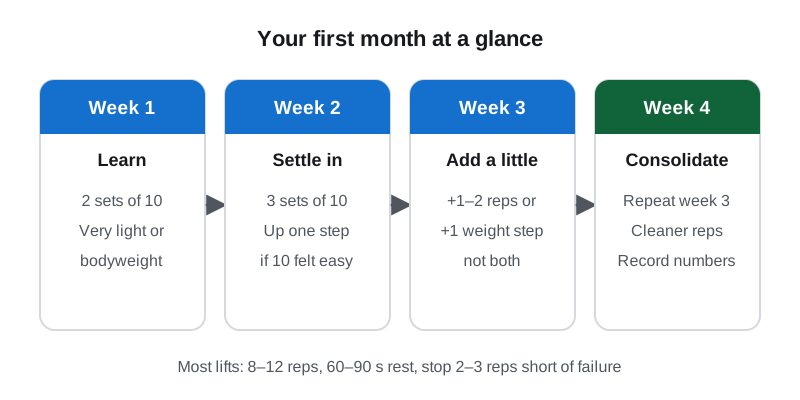 Each week changes one thing: sets in week 2, load or reps in week 3, quality in week 4.
Week 1: learn the movements
Alternate sessions A and B. Do 2 sets of 10 with very light weights or bodyweight. Focus on how each movement feels, and film a set on your phone if no one is checking your form.
Week 2: settle in
Same exercises. Move to 3 sets on the ones that felt smooth. If 10 reps felt easy with good form, go up one small step in weight.
Week 3: add a little
Add either 1–2 reps per set or a small weight increase on each lift, not both at once. Use the smallest step your gym has, often 1–2.5 kg for dumbbells or one plate on a machine.
Week 4: consolidate
Repeat week 3's weights and make every rep cleaner. If you feel run down, drop to 2 sets. At the end of the month, write down the weight and reps for each lift so month two has a starting point.
How to progress safely
The principle is progressive overload: small, regular increases in what you ask of your muscles. The simplest method for beginners is "double progression":
- Choose a rep range, such as 8–12.
- When you hit 12 reps on every set with good form, increase the weight one step.
- Drop back to 8 reps with the new weight and build up again.
Keep a log in your phone notes. Once you have a few weeks behind you, our one-rep max calculator can estimate working weights, but there is no need to test a maximum in month one.
Soreness: what is normal
Stiffness 24–72 hours after a new workout is common and is called delayed onset muscle soreness (DOMS). It is usually worst in the first week or two and fades as your body adapts to repeating the same exercises. A review by Cheung, Hume and Maxwell in Sports Medicine (2003) notes that the intensity and duration of exercise are important factors in DOMS, that the lowering (eccentric) phase causes more of it, and that new exercises should be introduced progressively. That is the case for starting light.
- Walking, light movement and good sleep help
- Soreness does not measure a good workout
- Sharp pain, joint pain, swelling, or pain that worsens during a movement is not normal; stop and get it checked
Form basics
- Brace your trunk before each rep, as if about to be poked in the stomach
- Keep a neutral spine on squats, hinges and rows
- Lower the weight under control; do not drop it
- Use the full range of motion you can control
- Breathe out on the effort, in on the return
If an exercise hurts, swap it for a variation (box squat for goblet squat, glute bridge for Romanian deadlift) rather than pushing through.
Eating to support training
You do not need a special diet, but enough protein helps recovery. The International Society of Sports Nutrition suggests 1.4–2.0 g of protein per kg of body weight a day for people who train regularly, in meals of roughly 20–40 g. For a 65 kg person that is about 90–130 g a day; 25–30 g at each of four meals gets you to 100–120 g. On a vegetarian diet, useful sources include dal, paneer, curd, chana, rajma, soya chunks and milk; eggs and chicken work if you eat them. Try our protein calculator for a personal number.
If you have a medical condition, are pregnant or have an injury, check with your doctor before starting strength training.
When a gym or home workouts suit you better
A coach is worth paying for if:
- You have never lifted and do not know where to start
- You are returning after an injury or a long break
- You are unsure about your form, or something hurts
- You have started and stopped several times and need accountability
If a gym is not practical right now, bodyweight squats, glute bridges, incline push-ups against a counter and backpack rows at home cover the same patterns for the first month. The NHS strength exercise guide has simple versions. Read personal training vs working out alone for a fuller comparison.
Sources
- WHO: physical activity recommendations for adults
- NHS: physical activity guidelines for adults aged 19 to 64
- NHS: strength exercises
- International Society of Sports Nutrition position stand: protein and exercise, JISSN (2017)
- Cheung K, Hume P, Maxwell L. Delayed onset muscle soreness: treatment strategies and performance factors, Sports Medicine (2003), PubMed
Frequently asked questions
How many days a week should a beginner do strength training?
Two or three full-body sessions a week with a rest day between them is enough. The WHO recommends muscle-strengthening activity on at least two days a week, so two sessions meet the guideline. Add a third only when recovery feels easy.
Will strength training make me bulky?
Not in the first month, and not without years of dedicated training and eating for it. Most beginners notice better posture, energy and strength well before any visible size change.
What weight should I start with as a beginner?
Pick a weight you can lift for 10 smooth reps with two or three more left in the tank. For many beginners that is bodyweight or 2.5–5 kg dumbbells for upper-body lifts and 6–10 kg for goblet squats, but it varies widely. Start too light rather than too heavy.
Should I use machines or free weights?
Both work. Machines are easier to learn and good for confidence, while dumbbells and kettlebells teach balance and control. A mix of the two suits most beginners.
Can I do cardio in my first month too?
Yes. Walking or light cycling on non-strength days is a good idea. Keep it easy enough that it does not leave you too tired for your strength sessions.
How long before I see results from strength training?
Many people feel stronger within three to four weeks, mostly because technique and coordination improve. Visible changes take longer and vary from person to person.
Train with us
Our strength training programme is built for beginners, and members often mention beginner-friendly coaching and a no-ego atmosphere. Visit our DLF Phase 4 gym, rated 4.9 from 415 Google reviews, or join our Sector 43 gym, opening 1 January 2027, with 20% off every plan reserved before opening. Message us on WhatsApp at +91 81303 92980 to get started.