 Zealous Fitness
Personal training is worth it if you are a beginner, returning after an injury or a long break, or stuck on a plateau you cannot explain. Working out alone is fine if you already know the main lifts, follow a written plan and turn up without someone waiting for you. Small studies suggest people lift heavier and progress faster with a trainer watching, but many people do best with a mix: four to eight weeks of coaching, then mostly solo training with regular check-ins.
Neither is better for everyone. The right choice depends on your experience, goals, budget and how you handle motivation after a long day in Cyber City.
Personal training vs working out alone: what the research says
There is not a huge body of research, and the studies are small, so treat these as useful hints rather than proof.
- Supervised lifters progressed faster. In a 12-week study (Mazzetti and colleagues, 2000), 20 moderately trained men were randomly assigned to the same programme, either supervised by a trainer or alone; 18 were analysed. The supervised group increased their training loads faster and ended with greater squat and bench press strength.
- People choose heavier weights with a trainer. When 46 trained women were asked to pick a weight for 10 reps (Ratamess and colleagues, 2008), those who trained with a personal trainer chose about 51% of their one-rep max on average, against about 42% for those who trained alone.
- The effect held in men and women. A 2017 study of 21 trained adults (Dias and colleagues) found self-selected loads 12–27% higher, depending on the exercise, in people who trained with a trainer. Even that group still chose loads well below what they could lift for 10 reps.
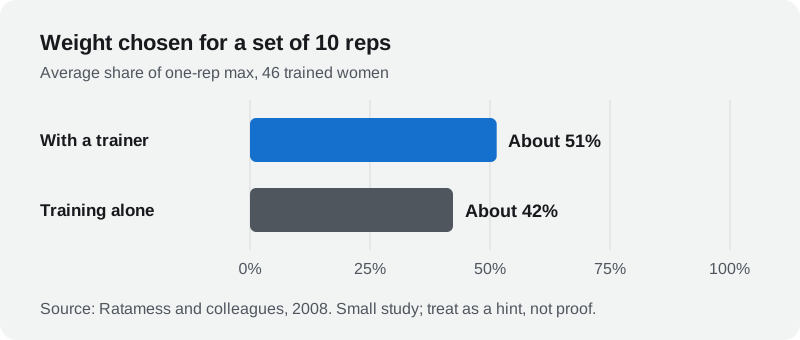
In one small study, women who trained with a coach picked noticeably heavier working weights than those who trained alone.
None of these studies looked at beginners, at injury rates or at whether people kept training after the study ended, so they cannot tell you a coach prevents injuries or makes you stick with it. The pattern they do show is consistent: on your own, you probably go lighter than you could. That matters because progressive challenge is what drives strength gains. It does not mean you need a trainer forever. It means solo lifters should track their weights and push deliberately.
Side-by-side comparison
| Factor | Personal training | Working out alone |
|---|---|---|
| Cost | Higher; sessions are paid on top of membership | Membership only |
| Form and safety | Real-time correction | Depends on your knowledge, videos and self-checks |
| Programme | Built and adjusted for you | You design or choose one |
| Loading | Coach pushes you to work hard enough | Tends to be lighter than you could manage |
| Motivation | Someone is expecting you | Relies on your own habits |
| Flexibility | Fixed slots you book in advance | Train whenever you like |
| Best for | Beginners, rehab, plateaus, specific goals | Experienced, self-directed lifters |
Who benefits most from a coach
Complete beginners. A few weeks on squatting, hinging, pushing and pulling builds habits you keep for years. Our guide to strength training for beginners in the first month shows what that stage covers.
People returning after a break or injury. After pregnancy, surgery, a back problem or years off, a trainer can scale exercises, watch for compensation and progress you gradually. Get clearance from your doctor or physiotherapist first.
Anyone on a plateau. If your lifts have not moved in months, a coach can spot whether the problem is effort, exercise choice, recovery or consistency.
People who struggle to show up. Long hours and a 45-minute crawl on the Sohna Road or NH-48 make it easy to skip. A booked session with someone waiting is one of the most reliable ways to keep going.
Specific goals. A first pull-up, a Himalayan trek in May or a sport season is easier with someone planning backwards from the date.
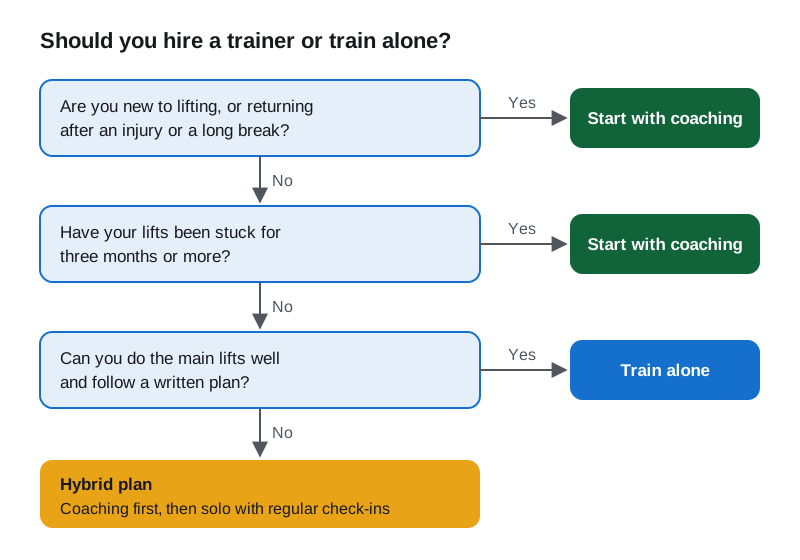
Three questions settle most cases; a hybrid plan covers everyone in between.
When working out alone is fine
Solo training works well if most of these are true:
- You can perform the main lifts with good form and know how to check it
- You follow a written programme and log every session
- You have trained consistently for six months or more
- You know the difference between muscle soreness and joint pain
A simple solo week, three days on non-consecutive days:
| Exercise | Sets × reps | Progress when |
|---|---|---|
| Goblet or barbell squat | 3 × 8 | All sets done with clean form |
| Romanian deadlift | 3 × 8 | All sets done with a flat back |
| Dumbbell or barbell press | 3 × 8 | Last rep is still controlled |
| Seated or dumbbell row | 3 × 10 | No body swing |
| Plank | 3 × 30 seconds | You can hold 45 seconds |
Add a little weight, about 2.5 kg on lower-body lifts or the next dumbbell up, when you hit every rep. Given the research above, be honest about whether your last set was hard; most solo lifters stop with several reps in the tank. A one-rep max calculator helps you set working weights without testing a true maximum.
The money maths: what each route costs over six months
Personal training prices vary a lot between gyms and trainers, so get a written per-session quote and plug it in as P. Over 26 weeks:
| Route | Coached sessions in 6 months | Cost on top of membership |
|---|---|---|
| Coach twice a week throughout | 52 | 52 × P |
| Hybrid: 2–3 a week for 6 weeks, then check-ins at weeks 10, 14, 18 and 22 | 12–18 + 4 = 16–22 | 16–22 × P |
| Solo with two form checks | 2 | 2 × P |
The hybrid route costs roughly a third to two-fifths of ongoing coaching and still puts a coach in front of you during the weeks when habits and technique form. Before you pay for a package, ask four things in writing: the per-session price, how long a session is, the cancellation and rescheduling rule, and whether unused sessions expire.
The middle path: a hybrid plan
You do not have to choose one forever:
- Front-load coaching. Two or three coached sessions a week for four to eight weeks, while you learn the lifts.
- Then train solo on a written plan, logging every set.
- Book a check-in every four weeks to review form and update the plan.
- Use group formats such as TRX or strength and conditioning for coaching at a different level of individual attention.
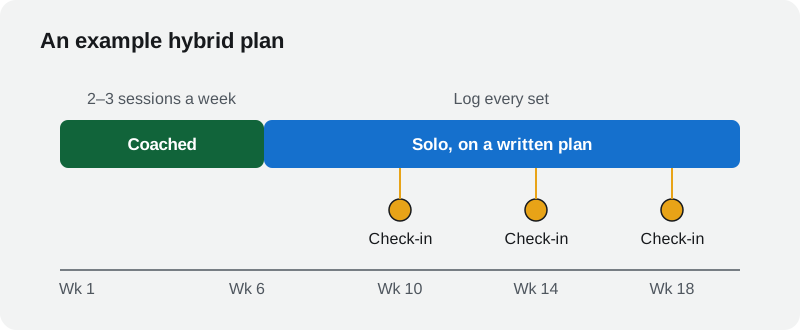
An example hybrid plan: coaching when it matters most, then tapering to check-ins every four weeks.
For a Gurgaon office schedule, it often helps to book coached sessions early in the morning, when meetings and traffic have not taken over, and keep solo sessions for flexible evenings or weekends.
How to choose a good trainer
Look for someone who:
- Asks about your history, injuries, sleep and work hours before training you
- Explains why each exercise is in your plan
- Prioritises form and progresses you gradually
- Listens when something feels wrong
- Is clear about cost, session length, cancellations and rescheduling before you pay
Ask which certification they hold and what it covered, and ask to see a sample programme. A trial session will tell you a lot.
Returning with a stiff back or an old injury
This is where a coach earns the fee most clearly, but only alongside medical advice. The NHS advises people with back pain to stay active and keep up daily activities, and to stop and see a doctor if pain gets worse. Seek urgent help, not a trainer, for numbness or weakness in both legs, loss of feeling around the genitals or bottom, or changes in bladder or bowel control.
When another option suits you better: if you have a diagnosed injury or ongoing pain, start with a physiotherapist and bring their written advice to your trainer. A good trainer will ask for it.
If you have a medical condition, are pregnant or have an injury, check with your doctor before starting any new training, with or without a coach. The NHS recommends strengthening activity on at least two days a week, and either route can get you there.
Train with us
Zealous Fitness offers personal training, and members often mention coaches Praveen and Ramal and the beginner-friendly, no-ego atmosphere. Visit our DLF Phase 4 gym, rated 4.9 from 415 Google reviews, or our Sector 43 gym, opening 1 January 2027. Message us on WhatsApp at +91 81303 92980 to ask how personal training works and what it costs.
Sources
- Mazzetti SA and colleagues (2000). The influence of direct supervision of resistance training on strength performance. Medicine and Science in Sports and Exercise
- Ratamess NA and colleagues (2008). Self-selected resistance training intensity in healthy women: the influence of a personal trainer. Journal of Strength and Conditioning Research
- Dias MRC and colleagues (2017). Influence of a personal trainer on self-selected loading during resistance exercise. Journal of Strength and Conditioning Research
- NHS. Physical activity guidelines for adults aged 19 to 64
- NHS. Back pain
Frequently asked questions
Is personal training better than working out alone?
For beginners, people returning from injury and anyone stuck on a plateau, usually yes: small studies suggest people lift heavier and gain strength faster with supervision. If you already train well on your own, the extra cost may add little. Coaching is most worth it when it prevents injury, saves months of trial and error or keeps you consistent.
How many personal training sessions do I need?
There is no study-backed number. A practical starting point is two or three sessions a week for four to eight weeks, about 12–18 sessions, which is enough to learn the main lifts and a written plan. People with specific goals or injuries often stay with a coach longer.
Can I get results without a personal trainer?
Yes. Many people progress steadily alone by following a structured programme, logging their training and pushing their working sets hard enough. Coaching mainly speeds up learning and reduces mistakes.
How do I know if my form is wrong?
Common signs are pain in joints rather than muscles, one side working harder than the other, or a weight you cannot control on the way down. Filming yourself from the side helps, and asking a coach to watch one set is the quickest check.
Is personal training good for weight loss?
A trainer can help with consistency and building muscle, both of which support fat loss. Food intake still has the biggest effect on the scale, so no training style guarantees a result.
Where can I find personal training in Gurgaon?
Most gyms in Gurgaon offer it, so compare the trainer's approach rather than the brochure. Zealous Fitness offers personal training at DLF Phase 4, and at Sector 43 from 1 January 2027; message +91 81303 92980 for details.