 Zealous Fitness
Most healthy Indian adults need about 0.83 g of protein per kg of body weight a day, the ICMR-NIN recommended allowance, which is roughly 54 g for a 65 kg adult. If you lift weights or train hard, the International Society of Sports Nutrition (ISSN) suggests 1.4–2.0 g per kg, or about 90–130 g for the same person. On an Indian diet, you get there by adding a deliberate protein food such as paneer, curd, soya, dal or eggs to every meal, not by living on supplements.
How much protein you need per day, by weight
| Body weight | Baseline (0.83 g/kg) | Cereal-heavy diet (1.0 g/kg) | Training (1.4–2.0 g/kg) |
|---|---|---|---|
| 55 kg | 46 g | 55 g | 77–110 g |
| 65 kg | 54 g | 65 g | 91–130 g |
| 75 kg | 62 g | 75 g | 105–150 g |
ICMR-NIN's own reference adults are a 65 kg man (54 g a day) and a 55 kg woman (45.7 g a day). Four details are worth knowing:
- Cereal-based diets need a bit more. ICMR-NIN notes that people eating a cereal-based diet with low-quality protein need about 1 g per kg. That describes many roti-rice-thin-dal plates. Its fix is a cereal, legume and milk ratio of roughly 3:1:2.5 by weight, so about one katori of dal and a glass of milk or curd for every three servings of roti or rice.
- There is a ceiling for muscle gain. A 2018 meta-analysis of 49 trials and 1,863 people (Morton and colleagues) found that beyond about 1.62 g per kg a day, extra protein added no further gains in muscle mass from training, on average. For a 65 kg person, that is about 105 g.
- Fat loss is the exception. ISSN says lifters eating in a calorie deficit may need more, up to 2.3–3.1 g per kg, to hold on to muscle. That is a target for experienced lifters on a planned cut, not for most beginners.
- Pregnancy and breastfeeding add to the baseline. ICMR-NIN adds about 9.5 g a day in the second trimester, 22 g in the third and 16.9 g in the first six months of breastfeeding. Your obstetrician or dietitian should set the number.
The two bodies do not fully agree. ICMR-NIN's allowance covers almost all healthy adults, and its director said at the 2024 guidelines launch that protein needs depend on body weight, not activity. ISSN's range is aimed at people who train to build muscle. Desk-bound and not lifting: the ICMR-NIN number is enough. Lifting three or more times a week: aim for the ISSN range.
| Your situation | Daily target to aim for | Source |
|---|---|---|
| Healthy, mostly desk-bound | 0.83 g per kg | ICMR-NIN |
| Mostly roti, rice and thin dal | About 1 g per kg | ICMR-NIN |
| Lifting 3 or more times a week | 1.4–2.0 g per kg | ISSN |
| Most muscle gain plateaus by | About 1.6 g per kg | Morton 2018 |
| Lifting while cutting calories | Up to 2.3–3.1 g per kg | ISSN |
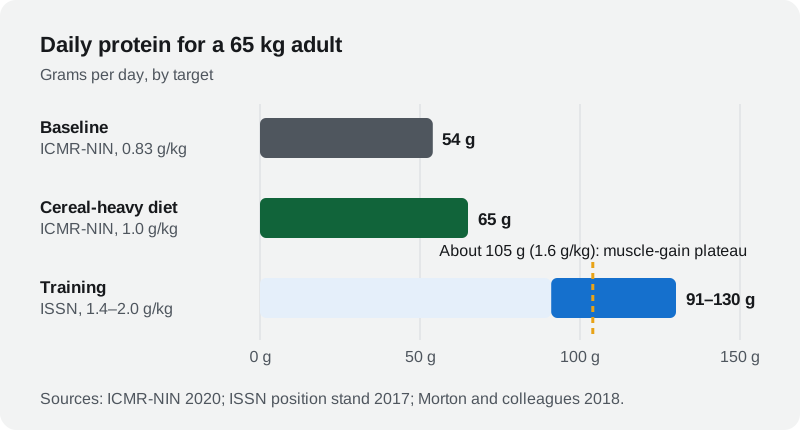
For a 65 kg adult, the training range starts well above the baseline, and most of the muscle-building benefit is reached by about 105 g.
Our protein calculator does the maths from your weight and activity; pair it with the calorie calculator if you are also changing how much you eat.
If you have kidney disease or another medical condition, are pregnant, or are recovering from an injury, check with your doctor before increasing protein significantly.
Why it is harder on a typical Indian plate
A common Gurgaon workday: chai and biscuits, poha or a paratha, roti-sabzi-dal from the office canteen, a samosa at 5 pm, and rice with dal after a long drive home on Golf Course Road. It is filling, but it is built around cereals, and the dal is often small and thin. You do not need a different cuisine, just bigger, deliberate servings of protein foods already in your kitchen.
Indian protein sources, compared
Values are approximate and vary with brand, recipe and how much water goes into cooking. Use them to estimate, not to count to the gram.
| Food | Typical serving | Approx. protein |
|---|---|---|
| Cooked dal (moong, masoor, toor) | 1 katori (about 150 g cooked) | 7–9 g |
| Cooked rajma or chhole | 1 katori (about 150 g cooked) | 7–9 g |
| Paneer | 100 g | 18 g |
| Curd (dahi) | 1 cup (about 200 g) | 6–8 g |
| Hung curd or Greek yoghurt | 100 g | 8–10 g |
| Milk | 1 glass (250 ml) | 8 g |
| Soya chunks | 30 g dry | 15 g |
| Tofu | 100 g | 8–12 g |
| Roasted chana | 30 g (a small handful) | 6 g |
| Peanuts | 30 g | 7 g |
| Besan chilla | 2 medium (about 40 g besan) | 8–9 g |
| Roti | 1 medium | 3 g |
| Egg | 1 large | 6 g |
| Chicken breast, cooked | 100 g | 25–30 g |
| Fish, cooked | 100 g | 20–25 g |
| Whey protein | 1 scoop (about 30 g) | 20–25 g |
Paneer, soya and chicken do a lot of work in a small serving. A katori of dal is useful, but on its own it is not a large dose: you would need about six katoris to reach 50 g.
A sample vegetarian day with 90 g of protein
This is for a 65 kg person aiming for about 1.4 g per kg, using everyday foods and no supplement.
| Meal | What to eat | Approx. protein |
|---|---|---|
| Breakfast, 8 am | 2 besan chillas with 1 cup of curd | 15 g |
| Mid-morning, 11 am | 1 glass of milk (250 ml) | 8 g |
| Lunch, 1:30 pm | 2 rotis, 1 katori dal, 100 g paneer bhurji or sabzi, salad | 32 g |
| Evening, 5 pm | A handful of roasted chana instead of biscuits | 6 g |
| Dinner, 8:30 pm | Soya chunk curry (30 g dry), 1 katori rajma, 2 rotis | 29 g |
| Total | 90 g |
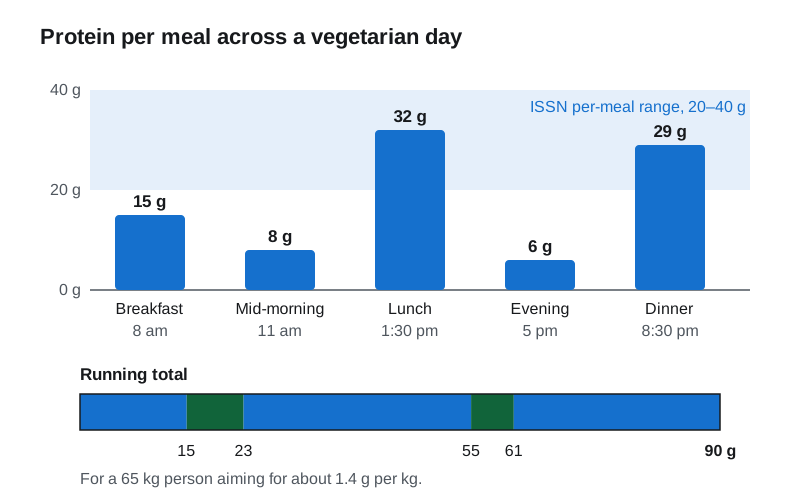
Lunch and dinner each land inside the 20–40 g per-meal range ISSN suggests; breakfast is the meal most worth topping up.
Easy swaps if you eat eggs, chicken or fish:
- Eggs: a 3-egg omelette with toast in place of the chillas gives about 20–23 g, slightly more than the chillas and curd.
- Chicken or fish: 100 g at dinner covers what the soya and rajma do here.
- No paneer at lunch: a 150 g bowl of hung curd plus a second katori of dal gets you close.
Making it work on a Gurgaon office day
In a day like the one above, breakfast and the long gap before a late dinner are the weak spots. A few habits fix that:
- Pack protein for the commute. Roasted chana, peanuts or a small tub of hung curd travel well for a day at Cyber City or Udyog Vihar and survive a long cab ride.
- Order smarter. On delivery apps, paneer tikka, dal with a side of raita, egg bhurji or grilled chicken beat a second naan or a biryani with little protein in it.
- Spread it out. ISSN suggests 20–40 g per meal, roughly every 3–4 hours. One big dinner after a 9-hour day is less useful than three or four decent servings.
- Eat near training. A protein-containing meal within a few hours either side of your session is enough; ISSN says both before and after work.
Do you need protein powder?
Usually not. ICMR-NIN's 2024 Dietary Guidelines for Indians, as reported when they were released, advise against protein supplements for building muscle and link prolonged intake of large amounts of protein powder to bone mineral loss and kidney damage. ISSN takes a more relaxed view: food first, with a supplement as a practical way to fill a gap.
The size of the benefit is worth knowing. In Morton's meta-analysis, adding protein supplements to weight training gave, on average, about 2.5 kg more on a one-rep max and 0.3 kg more lean mass over the study periods. That is real but small. In practice, whey or a plant protein is reasonable if you are vegetarian, train hard and keep falling 20–30 g short after fixing your meals. It is convenient, not required.
Is high protein safe for your kidneys?
For healthy adults, the best evidence is reassuring. A 2018 meta-analysis of 28 trials and 1,358 people (Devries and colleagues) compared higher-protein diets, at least 1.5 g per kg or 100 g a day, with normal or lower intakes and found no difference in how kidney function changed. That finding does not cover people with kidney disease: they should follow their doctor's limit.
When another approach suits you better: if you have diabetes, kidney problems or a thyroid condition, or you are pregnant, a registered dietitian can set a target around your health rather than your training. And protein does not replace training: if you are new to lifting, start with our guide to strength training for beginners.
Train with us
Protein only builds muscle you are asking to grow. Our strength training and personal training programmes are good places to start, and members often mention the beginner-friendly coaching. Visit our DLF Phase 4 gym, rated 4.9 from 415 Google reviews, or our Sector 43 gym near HUDA City Centre metro, opening 1 January 2027. Message us on WhatsApp at +91 81303 92980.
Sources
- ICMR-NIN (2020). A brief note on nutrient requirements for Indians, the recommended dietary allowances and estimated average requirements
- Jäger R and colleagues (2017). International Society of Sports Nutrition position stand: protein and exercise. Journal of the International Society of Sports Nutrition
- Morton RW and colleagues (2018). A systematic review, meta-analysis and meta-regression of the effect of protein supplementation on resistance training-induced gains in muscle mass and strength in healthy adults. British Journal of Sports Medicine
- Devries MC and colleagues (2018). Changes in kidney function do not differ between healthy adults consuming higher- compared with lower- or normal-protein diets: a systematic review and meta-analysis. Journal of Nutrition
- ICMR-NIN (2024). Dietary guidelines for Indians (not linked; we could not verify a stable official URL). Reported in South First, 10 May 2024: ICMR releases dietary guidelines for Indians after 13 years and Down To Earth, 9 May 2024
Frequently asked questions
How much protein do I need per day in grams?
Multiply your weight in kg by 0.83 for the ICMR-NIN baseline, or by 1.4–2.0 if you train regularly. A 65 kg adult needs about 54 g a day as a baseline and about 90–130 g when lifting. The protein calculator does this for you.
Can vegetarians get enough protein without supplements?
Yes, most vegetarians can reach 1.2–1.6 g per kg with deliberate choices. Paneer, soya, tofu, curd, milk and generous servings of pulses do most of the work. Supplements only make busy days more convenient.
Is too much protein bad for you?
For healthy adults, a 2018 meta-analysis of 28 trials found no harm to kidney function from intakes of 1.5 g per kg or more. People with kidney disease or other medical conditions should follow their doctor's advice. Very high intakes also tend to crowd out vegetables, fruit and fibre.
Should I calculate protein on my current weight or goal weight?
If you are close to a healthy weight, use your current weight. If you have a lot of weight to lose, many people use their goal weight or a value in between, which gives a more realistic target.
Does dal alone give enough protein?
Not usually. One katori of cooked dal gives about 7–9 g, so you would need several large servings to meet a training target. Pair dal with curd, paneer, soya, eggs or meat across the day.
How much protein should I eat after a workout?
ISSN suggests 20–40 g of good-quality protein per meal, and the meal can come before or after training. A plate of paneer bhurji with rotis, 3 eggs, or 100 g of chicken each gets you most of the way. Timing matters far less than your daily total.