 Zealous Fitness
New Year fitness resolutions stick when they are small, specific and scheduled, rather than big and vague. "Strength training Monday, Wednesday and Friday at 7 am" works far better than "get fit this year". Phrase the goal as something to do, not something to avoid, tick off every session, get someone to check in on you, and expect the habit to take around two months to feel automatic. Start with two or three short sessions a week and build from there.
Why most resolutions fade by February
It is rarely a lack of willpower. The usual problems are practical:
- The goal is too big. Going from zero to six days a week overhauls your whole routine.
- The goal is an outcome, not an action. "Lose 10 kg" tells you nothing about what to do on Tuesday evening.
- There is no plan for bad weeks. A late client call, a cousin's wedding or a week of smog derails everything.
- Progress feels invisible. Without a record, a good month can feel like nothing happened.
Myths you can ignore
| You may have heard | What the research we checked found |
|---|---|
| Only a tiny share of people keep resolutions | In a Swedish trial of 1,066 people, 55% of those who replied at one year said they had kept theirs |
| A habit takes 21 days | Around 66 days on average, from 18 days to a projected 254, in a UCL study |
| Miss a day and you are back to zero | A single missed day had little impact on later progress in the same study |
| Willpower is what matters | Planning when and where, tracking and support all made measurable differences |
What makes New Year fitness resolutions stick
Five findings are worth building around.
Approach goals beat avoidance goals. In the Swedish study (Oscarsson and colleagues, 2020), people whose goals were about doing something ("go to the gym three times a week") succeeded more often than those whose goals were about stopping something ("stop being lazy"): 58.9% against 47.1% at one year. Physical health and weight loss were the most popular resolutions.
A little support helps. In the same trial, people were randomly given no extra help, some support (information and exercises on goal setting) or extended support. The "some support" group was the only one that did significantly better. Telling a friend or booking a few coached sessions is a reasonable way to get that.
Habits take weeks, not days. A University College London study (Lally and colleagues, 2010) recruited 96 volunteers, 82 of whom finished, each adding one daily eating, drinking or exercise habit tied to a cue, such as a 15-minute run before dinner. Reaching near-automatic habit took 66 days on average, with individuals ranging from 18 days to a projected 254. A single missed day had little impact on later progress. Lally has since stressed that 66 is an average for one group, not a rule for everyone.
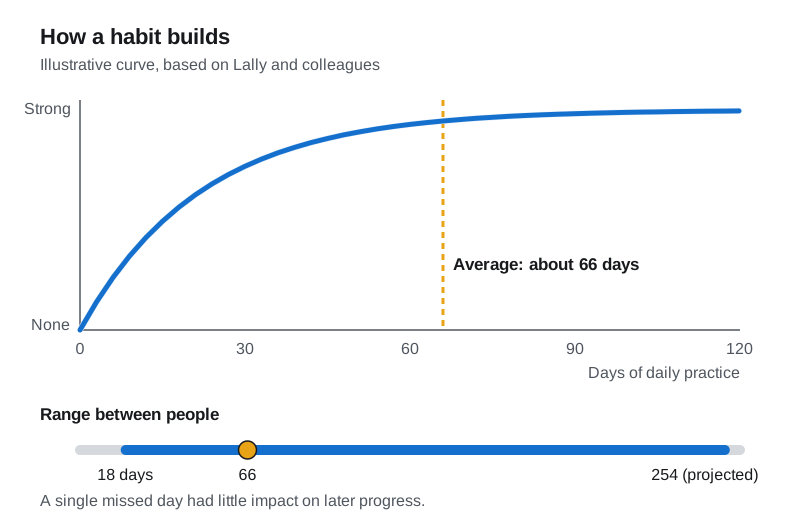
Habit strength climbs fastest early and then levels off; one missed day barely dents the curve.
When-and-where plans work. Psychologists call "when X happens, I will do Y" an implementation intention. A meta-analysis of 94 independent tests by Gollwitzer and Sheeran (2006) found these plans had a medium-to-large effect on reaching goals (d = 0.65).
Tracking helps, especially on paper or in public. A 2016 meta-analysis of 138 studies (Harkin and colleagues) found that monitoring progress improved goal attainment, with bigger effects when progress was physically recorded or shared with others.
Rewrite your resolution
| Vague resolution | Rewritten so it sticks |
|---|---|
| Get fit this year | Strength train Mon, Wed, Fri at 7 am at the gym near home |
| Lose 10 kg | Train 3 times a week and walk 7,000 steps on other days, for 8 weeks |
| Stop skipping workouts | If I miss Monday, I train Tuesday at the same time |
| Stop eating junk at work | Pack roasted chana and fruit for the 5 pm slump |
| Be more active | Take the stairs to the 6th floor every office day |
Then put it where you will see it:
- Book sessions like meetings. Add a time and a place to your calendar. For many people in Gurgaon, the slot that survives is before office, before the commute and the meetings take over; our guide to a morning workout before office covers how.
- Set a minimum. On a bad day, 15 minutes of squats, push-ups and planks at home still counts.
- Make it social. Tell a colleague, train with a friend or work with a coach; see personal training vs working out alone.
- Track sessions, not just weight. A tick on a wall calendar works. The scale fluctuates by a kilo or more day to day, especially in the first weeks.
Plan for a Delhi NCR January
January is a strange month to start in Gurgaon. Mornings are cold and foggy, wedding season fills weekends, and gyms are busiest in the first week as everyone starts at once. Winter air is the other problem: on 12 November 2026, Gurugram's AQI was 320, in the "very poor" band.
- Move outdoor plans indoors on high-AQI days. Swap a run along Golf Course Extension Road for an indoor session; our guide to working out in Gurgaon's pollution explains when.
- Avoid peak hours in week one if crowds put you off. Ask your gym which hours are quietest.
- Plan wedding weeks in advance. Two short sessions beat zero.
- Do not buy a year on 1 January. If you are not sure the habit will last, a 3-month plan you renew is cheaper than a 12-month plan you stop using in March; our guide to cancelling or freezing a gym membership has the maths.
If you have a medical condition, an injury, or are pregnant, check with your doctor before starting a new exercise routine. If you are returning with a stiff back, start with the lighter end of the plan below and stop and see a doctor if pain gets worse.
A 4-week starter plan
This plan assumes you are new to training or returning after a long break. The WHO recommends 150–300 minutes of moderate to vigorous activity a week, and the NHS adds strengthening on at least two days. You do not need that in week one; this plan builds towards it. Short on time, for example with young children? Repeat weeks 1 and 2 for a month before moving on; week 2 alone is 145 minutes.
| Week | Strength sessions | Extra | Weekly total |
|---|---|---|---|
| 1 | 2 × 30 min | 2 walks of 20 min | 100 min |
| 2 | 3 × 35 min | 2 walks of 20 min | 145 min |
| 3 | 3 × 40 min | 2 walks of 25 min | 170 min |
| 4 | 3 × 45 min | 1 extra class or walk, 30 min | 165 min |
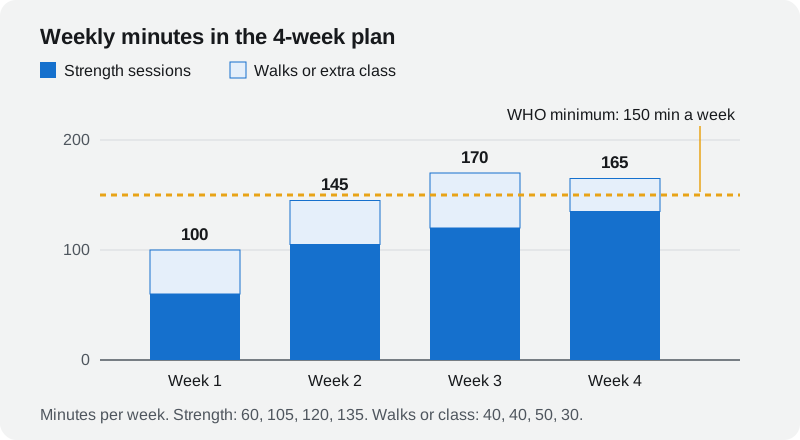
The plan crosses the WHO's 150-minute weekly minimum by week 3 without a sudden jump.
Week 1: show up. Two full-body sessions: goblet squat, dumbbell row, dumbbell press, glute bridge and plank, 2 sets of 10 reps (plank 20 seconds), light and controlled. Two 20-minute walks on other days. The only goal is attending every planned session.
Week 2: add a session. Three full-body sessions on non-consecutive days. Add a third set to two exercises if you feel good, and write down every weight so you have a baseline.
Week 3: build a little. Three sessions of about 40 minutes. Add 10 minutes of cycling or incline walking at the end of one or two sessions, and go up one dumbbell size on anything that felt easy.
Week 4: consolidate. Three 45-minute sessions, plus one different class, such as TRX, or a longer walk. At the end of the week, review: how many sessions you completed, what felt good, what got in the way. Adjust for February.
For lifting technique, read strength training for beginners. If you are also changing what you eat, the calorie calculator is a sensible starting point.
When another option suits you better: if a gym does not fit your life right now, a home routine of bodyweight exercises and brisk walks on cleaner-air days is far better than a membership you never use.
Train with us
A gym close to home or office removes a lot of friction; our guide on how to choose a gym in Gurugram walks through what to look for. Zealous is open now at DLF Phase 4, rated 4.9 from 415 Google reviews. Our Sector 43 gym at Gold Souk Mall, near HUDA City Centre metro, opens on 1 January 2027, with 20% off every plan until it opens. See our plans, or message us on WhatsApp at +91 81303 92980.
Sources
- Oscarsson M and colleagues (2020). A large-scale experiment on New Year's resolutions: approach-oriented goals are more successful than avoidance-oriented goals. PLOS ONE
- Lally P and colleagues (2010). How are habits formed: modelling habit formation in the real world. European Journal of Social Psychology, 40(6), 998–1009 (publisher page not linked; summarised by the British Psychological Society Research Digest and in Lally's 2026 University of Surrey interview)
- Gollwitzer PM and Sheeran P (2006). Implementation intentions and goal achievement: a meta-analysis of effects and processes. Advances in Experimental Social Psychology, 38, 69–119
- Harkin B and colleagues (2016). Does monitoring goal progress promote goal attainment? A meta-analysis of the experimental evidence. Psychological Bulletin
- World Health Organization (2020). Every move counts towards better health, says WHO
- NHS. Physical activity guidelines for adults aged 19 to 64
- Outlook India (13 November 2026). Gurugram air pollution: AQI 320
Frequently asked questions
How do I make my New Year fitness resolution stick?
Make it specific, scheduled and phrased as something to do, such as "train Monday, Wednesday and Friday at 7 am". Track every session and set a minimum for bad days. Start with two or three sessions a week rather than six.
How long does it take for exercise to become a habit?
It varies a lot. In one well-known study, people took 66 days on average to reach near-automatic habit, with individuals ranging from 18 days to a projected 254. Consistency matters more than the exact number.
How many days a week should a beginner work out?
Two or three days a week is a good start. The WHO recommends 150–300 minutes of moderate to vigorous activity a week, and the NHS adds strengthening on at least two days, which you can build towards over a month or two.
What if I miss a week?
Restart with your next planned session rather than waiting for Monday or next month. Missing occasionally does not undo progress; in habit research, a single missed day made little difference.
Should I set a weight-loss goal for the New Year?
Outcome goals can motivate, but pair them with action goals you control, such as sessions per week. If you are adjusting your diet, aim for steady, moderate changes rather than drastic cuts.
Is it better to join a gym in January or wait?
January is when most people join, so it is a natural time to start, but there is no advantage in waiting for a date. Starting in late December lets your routine settle before the first-week crowds; just read the membership terms before you pay.