 Zealous Fitness
A sauna after a workout is safe for most healthy adults and helps many people relax. The best direct evidence, an 8-week randomised trial, found that adding 15 minutes of sauna after exercise three times a week lowered systolic blood pressure by about 8 mmHg more than exercise alone. Keep it to 10–15 minutes after you cool down, drink water before and after, and skip it after alcohol, when unwell, or with unstable heart disease.
Sauna searches in India peak in December and January, which makes sense on a cold, smoggy Gurgaon morning. Here is what the evidence supports, what it does not, and a routine you can follow this week.
Sauna after workout benefits: what the research shows
Most sauna advice online mixes strong studies with wishful thinking. Here is the evidence sorted by how much weight it can carry.
The trial that tested exactly this. In a 2022 randomised controlled trial from Finland, 47 sedentary desk workers aged 30–64, most of them women, with at least one heart-risk factor, trained three times a week for eight weeks. One group added a 15-minute Finnish sauna straight after each session, starting at 65°C. Compared with exercise alone, the sauna group gained a little more aerobic fitness, and their systolic blood pressure ended 8 mmHg lower and total cholesterol about 19 mg/dL lower. It is one small study, diet was not controlled and there was no sauna-only group, but it is the closest match to "sauna after the gym".
The long-term Finnish cohort. The best-known study, in JAMA Internal Medicine (2015), followed 2,315 men aged 42–60 in eastern Finland for a median of about 21 years. Compared with once-a-week users, men who used a sauna four to seven times a week had a lower risk of fatal heart events and death from any cause. This is observational: it shows an association, not proof, and regular sauna users may differ in other ways.
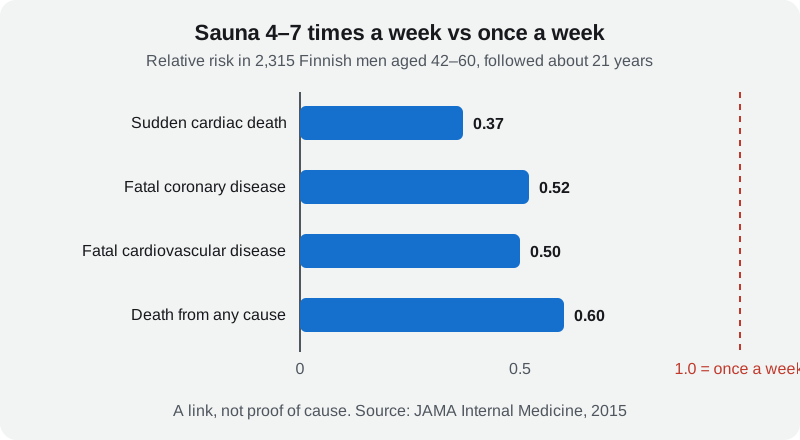 Lower bars mean lower risk than once-a-week users; an association in middle-aged Finnish men, not proof of cause.
| Claim you will see | What the evidence says | Verdict |
|---|---|---|
| Lowers blood pressure | 8 mmHg extra drop in systolic pressure in one 8-week trial | Promising, small evidence |
| Improves heart health | Lower fatal heart events in frequent users (Finnish cohort) | Association, not proof |
| Helps you relax | Widely reported, low risk | Reasonable |
| Speeds muscle recovery | Little direct evidence; warmth makes muscles feel looser | Unproven |
| Burns fat | Weight lost is water; it returns when you drink | No |
| "Detoxes" the body | Your liver and kidneys do that | No |
| Replaces exercise | WHO still recommends 150–300 minutes of moderate activity a week plus strength work | No |
How long to sit in a sauna after a workout
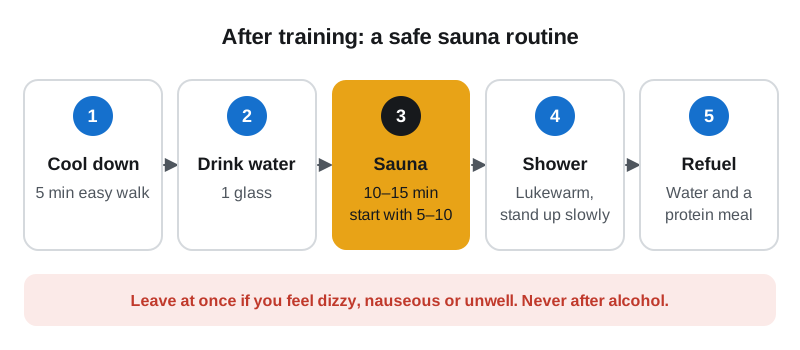 A safe post-workout sauna routine, start to finish, takes about 30 minutes.
- Cool down first. Walk for five minutes and let your heart rate settle.
- Drink a glass of water. More if you sweated heavily in training.
- Start short. Five to ten minutes for your first few visits, building to 10–15. The trial used 15 minutes; there is no need to go longer.
- Sit low if it feels too hot. Heat rises, so the lower bench is cooler. Sit still; push-ups or stretching in the heat add strain.
- Get out if you feel dizzy, nauseous or unwell. Never push through to hit a time.
- Stand up slowly. Heat lowers blood pressure, and standing quickly can make you light-headed.
- Cool off gradually. A lukewarm shower, then water and a meal with protein: dal and rice, paneer, curd or eggs.
A worked example: three sauna sessions a week
This copies the trial's pattern for someone training before office in Gurgaon.
| Time | Monday, Wednesday, Friday |
|---|---|
| 6:45–7:45 | Training: strength or cardio |
| 7:45–7:50 | Easy walk, glass of water |
| 7:50–8:05 | Sauna, 15 minutes (5–10 in week one) |
| 8:05–8:20 | Lukewarm shower, water, change |
| 8:20 | Breakfast and out the door |
That adds about 35 minutes to a session, so it suits days without an early meeting. Our guide to a morning workout before office has more timetables.
Who should avoid the sauna or check first
A review in The American Journal of Medicine found sauna use well tolerated by most healthy adults and safe for most people with stable angina or an old heart attack. It named three clear reasons not to use one: unstable angina, a recent heart attack and severe aortic stenosis.
Ask your doctor first if any of these apply:
- You have any heart condition, chest pain, or a heart attack in your history
- Your blood pressure is very high, very low, or treated with medicines
- You have kidney disease, epilepsy, or a condition that heat makes worse
- You are pregnant: evidence is limited and advice differs, so check with your obstetrician and avoid overheating
- You are feverish or unwell
Never use a sauna after drinking. The same review warns that alcohol during sauna bathing raises the risk of low blood pressure, abnormal heart rhythm and sudden death. Children should use one only briefly and with an adult.
Sauna vs steam room vs infrared sauna
| Traditional dry sauna | Steam room | Infrared sauna | |
|---|---|---|---|
| Air | Hot and dry; the trial started at 65°C with 10–20% humidity | Cooler air, close to 100% humidity | Cooler air; heaters warm your body directly |
| How it feels | Intense but breathable | Heavy and muggy | Gentler |
| Research base | The trial and Finnish cohort above | Much less | Smaller, newer studies |
"Infrared sauna" is a fast-rising search in India, but the headline studies in this article used traditional Finnish saunas, so do not assume infrared delivers the same results. The safety rules apply to all three.
The winter angle in Gurgaon
- AQI: a sauna does nothing for your lungs or for pollution exposure. On bad-air days, train indoors and follow our guide to working out in Gurgaon pollution.
- Hydration: you feel less thirsty in December, but you still lose fluid in training and in the heat. Water is enough for most people; nimbu pani with a pinch of salt is fine after a sweaty session.
- Cold plunges: popular online, but a cardiologist writing for Brown University Health advises people with heart disease not to jump into ice water or a cold pool after a sauna, because the sudden shock can upset heart rhythm and blood pressure. Cool off with a lukewarm shower instead.
When something else suits you better: if your goal is faster recovery for tomorrow's session, sleep, food and an easy walk matter more. If you dislike heat, you lose nothing important by skipping the sauna.
Sources
- Lee E et al. Effects of regular sauna bathing in conjunction with exercise on cardiovascular function: a multi-arm, randomized controlled trial, American Journal of Physiology (2022)
- Laukkanen T et al. Association between sauna bathing and fatal cardiovascular and all-cause mortality events, JAMA Internal Medicine (2015)
- Wu W-C. Saunas and your heart: is it safe to use a sauna if you have heart disease? Brown University Health (2023)
- Hannuksela ML, Ellahham S. Benefits and risks of sauna bathing. The American Journal of Medicine, 2001
- Laukkanen JA, Laukkanen T, Kunutsor SK. Cardiovascular and other health benefits of sauna bathing: a review of the evidence. Mayo Clinic Proceedings, 2018
- WHO: physical activity recommendations for adults
Frequently asked questions
Is sauna after workout good for you?
For most healthy adults, yes, if you cool down first, drink water and keep it to 10–15 minutes. One 8-week trial found it added a modest blood pressure benefit on top of exercise. It does not burn fat or replace training.
Is it better to use the sauna before or after a workout?
After. A long sauna before training can leave you tired and short of fluid, which hurts your session. Five minutes of easy cardio is a better warm-up.
How long should I sit in a sauna after the gym?
Most healthy adults do well with 10–15 minutes; beginners should start with five to ten. Leave straight away if you feel dizzy, sick or uncomfortable.
Does a sauna help you lose weight?
Not in any lasting way. The weight you lose is sweat, and it returns when you rehydrate. Fat loss depends on diet and activity, which our calorie calculator can help you plan.
Can I use a sauna every day?
Many healthy Finns do, and the most frequent users in the 2015 study went four to seven times a week. Two to four sessions a week after training is plenty. Check with your doctor first if you have heart or blood pressure problems or are pregnant.
Is a sauna safe with high blood pressure?
Often yes if it is well controlled, and the trial above found a small drop in systolic pressure. But heat lowers blood pressure further, so if you take medicine for it, ask your doctor first, stand up slowly and avoid alcohol.
Are infrared sauna benefits the same as a regular sauna?
Not necessarily. The studies most often quoted, including those here, used traditional Finnish saunas. Infrared research is smaller and newer, so its benefits are less certain.
Train with us
Our premium Sector 43 gym at Gold Souk Mall, near HUDA City Centre metro, opens on 1 January 2027 with a sauna and Pilates confirmed; ask us on WhatsApp at +91 81303 92980 for the full amenity list. Every plan reserved before opening is 20% off. Our DLF Phase 4 gym is open now for straightforward, no-frills training and is rated 4.9 from 415 Google reviews.