 Zealous Fitness
Pilates vs yoga comes down to emphasis. Pilates focuses on core control, posture and slow, precise strength work; yoga puts more weight on flexibility, balance, breathing and relaxation. Research finds both modestly helpful and neither clearly superior, and neither builds much muscle or replaces cardio. Pick the one you will enjoy twice a week, and pair it with strength training.
If you search "pilates near me" or "yoga near me" in Gurugram you will find plenty of options. This guide helps you choose by goal, start safely, and know when you want both.
Pilates vs yoga at a glance
| Pilates | Yoga | |
|---|---|---|
| Main focus | Core control, posture, precise strength | Flexibility, balance, breathing, relaxation |
| Pace | Slow and controlled | Very slow to fast, depending on style |
| Flexibility | Some improvement | Usually the bigger emphasis |
| Core strength | Central to the method | Present; varies by style |
| Breath and mind | Breathing supports movement | Breathing and mindfulness are central |
| Impact | Low | Low (hot and power styles are more demanding) |
| Builds muscle mass | Limited | Limited |
| Equipment | Mat, or machines such as the reformer | Mat; blocks and straps help |
| Cheapest way to start | A guided mat class | Free government routine at home, or a society or park class |
What Pilates is
Pilates is a system of controlled exercises developed by Joseph Pilates in the early 20th century. It trains the deep trunk muscles that support your spine and builds strength around the hips and shoulders through slow, deliberate movement.
It comes in two main forms:
- Mat Pilates: bodyweight exercises on a mat, sometimes with small props such as bands or a ring. Easy to start and to practise at home once you know the moves.
- Reformer Pilates: a sliding carriage with springs that add or reduce resistance. It can make some moves easier for beginners and others much harder, and it needs a studio or gym that has the machines.
A typical session: breathing while keeping your trunk braced, low-repetition precise exercises for core, hips and back, posture cues from the instructor, and small progressions each week. You may not sweat much, but you will feel muscles you did not know you had.
What yoga is
Yoga comes from Indian tradition and combines postures (asanas), breathing practices (pranayama) and often meditation. Styles range from slow and restorative (such as yin or restorative yoga) to fast and demanding (such as vinyasa or power yoga).
For an Indian reader there is a free, structured starting point: the Ministry of AYUSH's Common Yoga Protocol, a 45-minute sequence of loosening movements, standing, sitting and lying postures, breathing practices and meditation, published for International Day of Yoga. Many housing societies and parks in Gurugram run morning sessions too, often free or low cost.
What the research says
The evidence for both is real but modest.
| Question | What the best evidence found | Strength |
|---|---|---|
| Does Pilates build core strength? | A 2023 review of 8 trials (437 people with chronic low back pain) found Pilates about as good as other equally dosed exercise, and better than nothing | Very low certainty |
| Is Pilates better than other exercise for strength? | A 2022 review of 16 studies (689 people) found no clear difference for strength, balance or flexibility | Very low to low |
| Does yoga help low back pain? | A 2022 review of 21 studies (2,223 people) found yoga slightly better than no exercise, a difference that may not matter much to patients | Small effect |
| Does yoga help stress? | A 2020 review found benefits for perceived stress in all 12 studies (672 healthy adults) | Consistent, small studies |
| Does yoga help neck pain? | A 2019 review of 10 studies (686 people) found less pain and disability | Limited |
The honest reading: either is a good choice if you enjoy it. Neither is a guaranteed fix for back pain or a substitute for lifting.
Which to choose: decide by your main goal
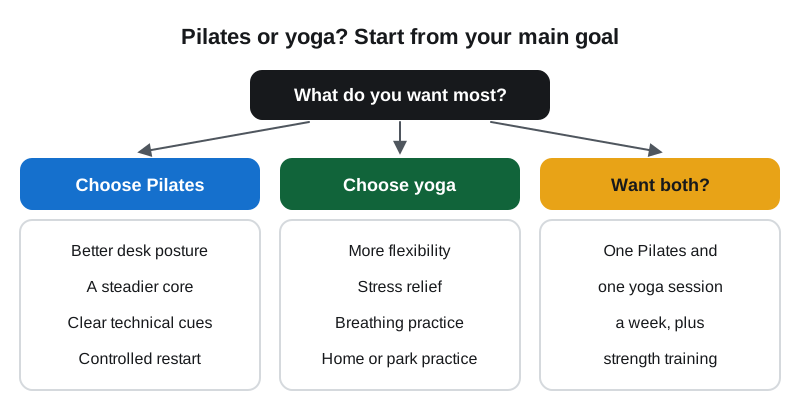 Start from your main goal; many people end up doing one of each a week.
| Your main goal | Better first pick | Why |
|---|---|---|
| Fixing desk posture after long days in Cyber City | Pilates | Trains the trunk and upper back muscles that hold you upright |
| A steadier core for lifting, running or cricket | Pilates | Direct carry-over to bracing under load |
| Feeling stiff, can't touch your knees | Yoga | Flexibility is the main emphasis |
| Stress and sleep | Yoga | Breathing and relaxation are built in |
| Easing back in after years off, with a stiff lower back | Either, with a qualified teacher | Get a doctor or physiotherapist's go-ahead first and tell the instructor |
| Lowest cost | Yoga | Free government routine and park classes |
| Weight loss | Neither on its own | Diet, walking and strength training matter far more |
Safety notes most comparisons skip
- Yoga injuries are mostly sprains and strains, usually knee or lower leg, according to the US National Center for Complementary and Integrative Health (NCCIH). Adults over 65 have a higher rate of yoga injuries treated in emergency departments than younger adults.
- Beginners should avoid headstands, shoulder stands, the lotus position and forceful breathing, NCCIH advises. Kapalbhati, which is part of the Common Yoga Protocol, is a forceful breathing practice, so learn it from a teacher and go gently, or skip it, especially if you are pregnant or have high blood pressure.
- Hot yoga adds a real risk of overheating and dehydration, which matters in a Delhi NCR summer.
- Glaucoma, severe high blood pressure, balance problems, lumbar spine disease or knee and hip injuries may need modified poses; head-down positions are the usual concern.
- Pregnancy: get your doctor's go-ahead, avoid hot yoga and avoid lying flat on your back for long periods. Choose a prenatal class.
- Pilates is low impact, but a poorly taught class can still strain your neck or lower back. A good instructor modifies moves rather than pushing you through them.
If you have a medical condition, are pregnant or postpartum, or are recovering from an injury, check with your doctor before starting either.
Combining either with strength training
Neither Pilates nor yoga is a full fitness plan. The WHO recommends 150–300 minutes of moderate aerobic activity a week plus muscle-strengthening activities on two or more days; adults over 65 with poor mobility should add balance work on three or more days. Lifting weights is the most direct way to build muscle and bone strength.
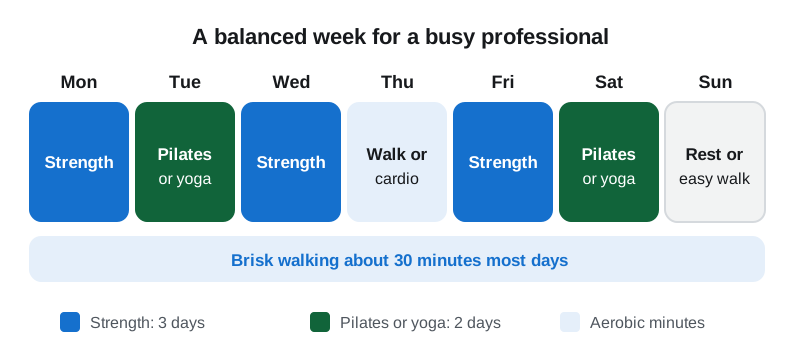 A balanced week: three strength days, two Pilates or yoga sessions, and walking to reach your aerobic minutes.
Pilates in particular carries over to lifting, because a braced trunk helps you squat and deadlift with better form. New to weights? Start with strength training for beginners, and use the protein calculator to set a daily target from dal, paneer, curd, eggs or chicken.
Your first month
| Week | What to do |
|---|---|
| 1 | Try one guided class of each. Tell both instructors about any injuries |
| 2 | Pick the one you looked forward to. Two sessions this week, plus two short strength sessions |
| 3 | Same again; note one move that felt hard in week 1 and see if it feels easier |
| 4 | Two sessions plus strength. Decide whether to keep going, switch, or add one of the other |
Questions worth asking any instructor or gym before you pay: what training or certification do you have, how many people are in a class, is it mat or reformer, and can I try one session first?
Practical tips for Gurgaon
- Winter mornings: on high-AQI days, swap outdoor park yoga for an indoor session so you keep the habit; see working out in Gurgaon pollution.
- Office hours: a 45–60 minute class fits before a 9:30 start or after work; two fixed slots a week beat good intentions.
- Know when a specialist suits you better: if you want daily classes, a wide timetable or lots of reformer work, a dedicated Pilates or yoga studio may serve you better than a gym.
Sources
- Pilates to improve core muscle activation in chronic low back pain: a systematic review, Healthcare (2023)
- Is Pilates better than other exercises at increasing muscle strength? A systematic review, Heliyon (2022)
- NCCIH: Yoga, effectiveness and safety
- Ministry of AYUSH: Common Yoga Protocol booklet, 2nd revised edition, 2016 (PDF, hosted by the Ministry of External Affairs)
- WHO: physical activity recommendations for adults
Frequently asked questions
Pilates vs yoga: which is better for beginners?
Both are beginner friendly with a good teacher. Pilates suits people who like clear technical cues and want core strength; yoga suits people who feel stiff or want stress relief. Try one class of each and keep the one you look forward to.
Is Pilates or yoga better for weight loss?
Neither burns many calories compared with brisk walking, cardio or strength circuits. Weight loss depends mostly on your overall diet and activity; our calorie calculator can help you plan.
Which is better for back pain, Pilates or yoga?
Research shows a small benefit for yoga and very-low-certainty evidence for Pilates, with neither clearly better than other exercise. Back pain needs proper assessment, so see a doctor or physiotherapist first and tell your instructor.
What is the difference between mat and reformer Pilates?
Mat Pilates uses your body weight on a mat and is easy to start anywhere. Reformer Pilates uses a spring-loaded sliding machine that can assist or add resistance, and it needs a studio or gym with the equipment.
Can I do Pilates or yoga instead of going to the gym?
They are a good part of a routine but not a complete one. Most adults also need regular strength training and aerobic activity, as WHO guidelines recommend.
How many times a week should I do Pilates or yoga?
Two sessions a week is a good start, alongside two or three strength sessions. If you do both methods, one of each a week works well.
Where can I do Pilates in Gurgaon?
Zealous Fitness will offer Pilates at its Sector 43 gym at Gold Souk Mall, which opens on 1 January 2027. Message +91 81303 92980 on WhatsApp to ask about the format and to register your interest.
Train with us
Our premium Sector 43 gym near HUDA City Centre metro opens on 1 January 2027, with Pilates and a sauna confirmed alongside strength training; every plan reserved before opening is 20% off. Our DLF Phase 4 gym is open now for straightforward strength and cardio work and is rated 4.9 from 415 Google reviews. Message us on WhatsApp to ask which one suits you.