 Zealous Fitness
A good TRX workout for beginners is six basic moves (row, chest press, squat, reverse lunge, Y-fly and rollout) done for 2–3 rounds of 8–12 slow reps, which takes 25–35 minutes with a warm-up. Suspension straps use your body weight, so you make any exercise easier or harder by changing your body angle. Train two or three times a week, with a rest day between sessions.
Below: how suspension training works, a safety checklist, the circuit with coaching cues, and the four levers that let one exercise suit almost anyone.
What a TRX workout is
Suspension training uses a pair of strong, adjustable straps with handles, anchored to a secure point above you. You hold the handles (or put your feet in the foot cradles) and lean, push or pull against your own body weight. TRX is the best-known brand, and many people use "TRX" to mean suspension training in general.
Because you are partly supported by the straps, the load changes the moment you move your feet. Stand nearly upright and a row is gentle. Walk your feet towards the anchor so you lean back further and it gets much harder. The straps also swing freely, so your trunk has to work throughout to keep you steady.
Does it actually build strength? A 12-week randomised trial (Soligon and colleagues, European Journal of Applied Physiology, 2020) split 42 untrained older adults between suspension training, traditional resistance training and no training. Both training groups gained similar muscle thickness, strength and functional performance. It was small and in older people, so treat it as encouraging rather than conclusive for younger lifters. A separate 2018 study of 88 experienced college students found a single 50-minute suspension session briefly raised jump height and leg force in the men but not the women, which says more about short-term effects than long-term gains.
Safety and setup basics
Suspension training is low risk when set up properly.
- Check the anchor. It must be designed to hold body weight, such as a purpose-built frame or rig. Never anchor to a door you are unsure about, a curtain rod or a ceiling fan.
- Inspect the straps. Look for fraying, cracked buckles or worn stitching.
- Set the length for the move. Most beginner exercises use mid-length, with handles roughly at waist height when the straps hang. Adjust before each exercise.
- Keep the straps taut. Slack straps cause a sudden drop when they catch.
- Avoid sawing. Do not let the straps rub back and forth against your arms.
- Move slowly. Two seconds down, one or two seconds up.
- Start upright. Begin with your body more vertical and progress the angle over weeks.
If you have a medical condition, a shoulder, back or knee injury, or are pregnant, check with your doctor before starting a new exercise programme.
The 6-exercise TRX circuit for beginners
Warm up for 5 minutes first: brisk walking, arm circles, hip circles and 10 bodyweight squats.
Do the exercises in order with about 30 seconds between moves. After the sixth, rest 1–2 minutes and repeat. Do 2 rounds in weeks 1–2, then build to 3.
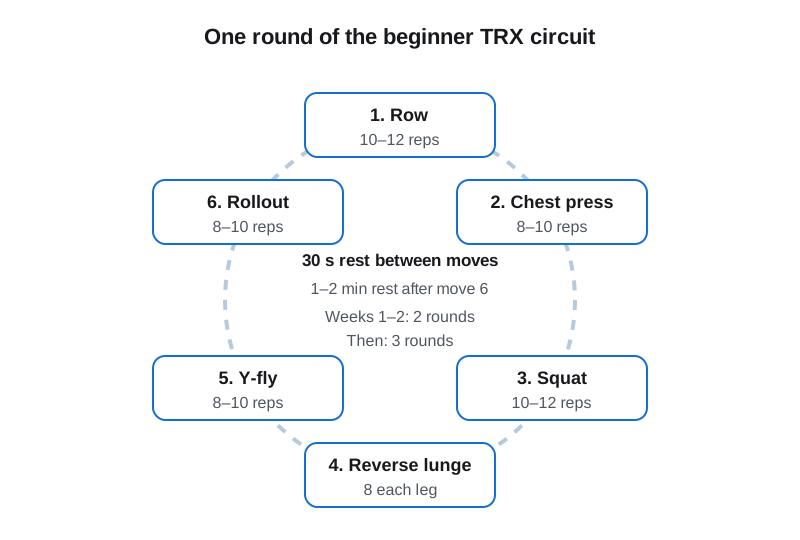 One round takes roughly 8–10 minutes including rests, so two rounds plus a warm-up is about 25 minutes and three rounds about 35.
| Exercise | Reps | Facing | Main muscles |
|---|---|---|---|
| TRX row | 10–12 | Towards anchor | Upper back, biceps |
| TRX chest press | 8–10 | Away from anchor | Chest, shoulders, triceps |
| TRX assisted squat | 10–12 | Towards anchor | Thighs, glutes |
| TRX assisted reverse lunge | 8 each leg | Towards anchor | Thighs, glutes, balance |
| TRX Y-fly | 8–10 | Towards anchor | Upper back, rear shoulders |
| TRX standing rollout | 8–10 | Away from anchor | Trunk |
1. TRX row
Face the anchor, hold a handle in each hand and walk your feet forward until you lean back with straight arms. Keep a straight line from head to heels. Pull your chest to the handles, squeezing your shoulder blades together, then lower slowly. A useful counter to hours hunched at a laptop.
2. TRX chest press
Face away from the anchor, arms straight in front at chest height, and lean forward. Bend your elbows to lower your chest between your hands, like a standing push-up, then press back. Brace so your hips do not sag.
3. TRX assisted squat
Face the anchor, arms extended. Sit back and down into a squat using the straps only lightly for balance, then stand. The support lets you sit deeper with an upright chest.
4. TRX assisted reverse lunge
Face the anchor, holding the handles. Step one foot back and lower into a lunge, then push through the front foot to return. Finish all reps on one side, then switch.
5. TRX Y-fly
Face the anchor and lean back slightly, arms straight in front. Keeping arms straight, sweep them up and out into a Y overhead, pulling yourself upright. Lower slowly. Stay nearly vertical; this works small shoulder muscles.
6. TRX standing rollout
Face away from the anchor, arms straight at shoulder height. Keeping your body rigid, raise your arms overhead so you lean forward, then pull back. Lean only as far as you can without your lower back arching.
How to make moves easier or harder
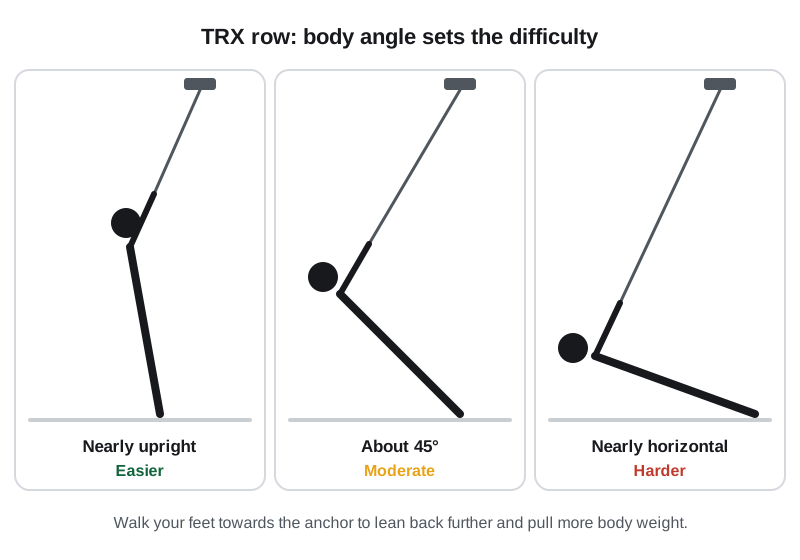 For rows, the further you lean back, the more of your body weight you pull.
One exercise can suit almost anyone. Four levers:
| Lever | Easier | Harder |
|---|---|---|
| Body angle (rows, Y-flies) | Step away from the anchor, stand more upright | Walk feet towards the anchor, lean back further |
| Body angle (presses, rollouts) | Stand more upright | Walk feet back, lean further forward |
| Stance | Feet wider apart | Feet together or on one leg |
| Tempo | 2 seconds down | 3–4 seconds down, 1-second pause at the hardest point |
Change one lever at a time. When 12 controlled reps feel easy for every round, make one move harder.
A four-week TRX plan for beginners
| Week | Rounds | Reps | What changes |
|---|---|---|---|
| 1 | 2 | 8 per move | Stand nearly upright on every exercise; learn the setup |
| 2 | 2 | 10–12 | Same angles; slow the lowering to 2 seconds |
| 3 | 3 | 10–12 | Walk your feet one small step to make two moves harder |
| 4 | 3 | 10–12 | Keep week 3's angles and add a 1-second pause at the hardest point |
If a week feels too hard, repeat it rather than moving on. Two sessions a week is enough to follow it; add a third only if you are not sore.
How often to do it, and when free weights suit you better
Two or three sessions a week, with a day off between, is ideal for beginners and matches the WHO and NHS advice of strength work on at least two days a week. On winter days when Delhi NCR's AQI rules out an outdoor run, an indoor suspension circuit is a good swap.
Be honest about the limits. Your body weight is a fixed load, so for big leg strength or muscle size, most people eventually need barbells and dumbbells too.
| Choose TRX if you | Choose free weights if you |
|---|---|
| Are new to training and want an easy way to scale | Want to build a lot of leg strength or muscle |
| Travel for work and want a portable option | Already find TRX rows and squats easy at a steep angle |
| Want trunk control and upper-back work after desk days | Prefer measurable progress in kilograms |
Sources
- WHO: physical activity recommendations for adults
- NHS: physical activity guidelines for adults aged 19 to 64
- Soligon SD et al. Suspension training vs. traditional resistance training: effects on muscle mass, strength and functional performance in older adults, European Journal of Applied Physiology (2020), PubMed
- Short-term effects of suspension training on strength and power performances, Journal of Functional Morphology and Kinesiology (2018)
- TRX Training (official site)
Frequently asked questions
Is TRX good for beginners?
Yes. Because you set the difficulty with your body angle, almost every exercise can be made gentle enough for a first session. It also teaches trunk control, which helps with other kinds of training.
What is a good TRX workout for beginners at the gym?
A six-move circuit of row, chest press, assisted squat, reverse lunge, Y-fly and standing rollout, for 2–3 rounds of 8–12 reps. Start standing nearly upright and lean further as you get stronger. It takes 25–35 minutes including a warm-up.
Can TRX build muscle?
It can build strength and some muscle, especially for beginners who progress the difficulty over time. One small 2020 trial in 42 older adults found gains similar to traditional resistance training over 12 weeks. As you get stronger, most people add free weights.
How long should a beginner TRX workout be?
About 25–35 minutes including a warm-up is enough. Focus on slow, controlled reps rather than going longer.
Can I do a TRX workout at home?
Yes, if you have an anchor that can safely hold your body weight and you follow the strap maker's anchoring instructions exactly. In a Gurgaon flat that rules out curtain rods, ceiling fans and doors you are unsure about. If you cannot be certain of the anchor, train at a gym with a purpose-built rig.
How many times a week should I do TRX?
Two or three times a week with a rest day between sessions suits most beginners. You can also use the circuit as a quick session on days you are short of time.
Train with us
TRX is one of our regular programmes at Zealous, and members often mention that coaches are patient with beginners, which helps when you are learning setup and angles. Train at our DLF Phase 4 gym, open now, or our Sector 43 gym near HUDA City Centre metro, opening 1 January 2027. Message us on WhatsApp at +91 81303 92980 for session timings.